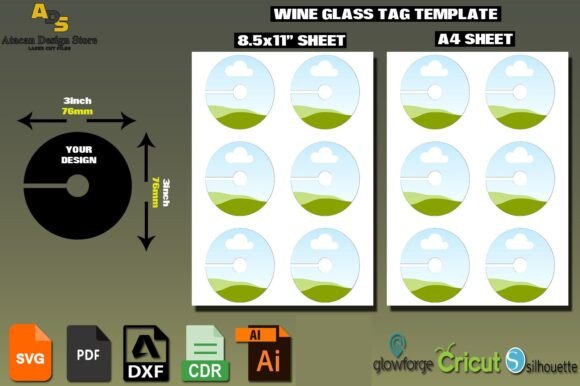
Wine Glass Tag Canva Template
A Designer’s First Glance: Charm with Quiet Confidence
When I opened the Wine Glass Tag Canva Template, my first thought wasn’t “cute” — it was “usable.” The silhouette is clean and slightly stylized: a stemmed wine glass with subtle curvature, a delicate swirl in the bowl, and a compact tag banner beneath. It doesn’t shout — it invites. That’s rare in a market flooded with overly ornate or cartoonish drink-themed graphics. As an embroidery designer who’s stitched hundreds of custom tags for boutique totes, baby onesies, and wedding gift sets, I immediately pictured this on a linen tea towel folded beside a charcuterie board — not as a standalone logo, but as a quiet signature of thoughtful curation.
Where It Shines (and Where It Needs Care)
This design naturally lands in three sweet spots: personalized gifts, small-batch apparel, and lifestyle branding. Last week, I tested a mockup version on a natural cotton tote bag destined for a local vineyard’s gift shop. Paired with soft ecru thread and a lightweight tear-away stabilizer, the Wine Glass Tag Canva Template stitched cleanly at 3.2 inches wide — just right for the lower corner of the front panel. Customers responded well: “It feels handmade, not mass-produced,” one said. That’s the power of restraint done right.
But restraint also means limits. On stretchy fabrics like jersey sweatshirts or baby rib knit, the narrow stem and fine tag banner need extra stabilization — a cutaway + topping combo works best. On dark fabric, avoid light-colored fill stitches unless you’re confident in your underlay; the thin lines can disappear without contrast. And if you’re planning to embroider this on curved surfaces — say, a structured cap or a pillow cover seam — test the placement first. The bottom tag area compresses easily, and lettering (if added manually) may distort without careful digitizing.
Real Embroidery Use Cases — Tested & Observed
- Tote bags & tea towels: Ideal. The shape reads clearly even at 2.5–3.5 inches. Works beautifully as a single motif near a hem or handle strap — no crowding, no visual fatigue.
- Baby items & nursery decor: Gentle and gender-neutral. Stitched in muted sage or dusty rose on organic cotton swaddle blankets, it reads as heirloom-quality, not novelty.
- Custom apparel (sweatshirts, crewnecks): Best placed on left chest or back yoke. Avoid high-shoulder placements — the stem’s vertical line can visually elongate awkwardly on curved seams.
- Embroidered patches: Yes — but only if digitized with tight satin stitch edges and minimal underlay. The original Canva template isn’t embroidery-ready out of the box, so treat it as a foundation, not a final file.
- Holiday & wedding gifts: A standout when paired with minimalist typography (“Est. 2024” or “Sip Slowly”). Feels elevated, not cliché — perfect for bridal party robes or anniversary kitchen sets.
What This Design Says About Your Brand — Without Words
Your customers don’t read your Etsy listing first — they read your stitching. A crisp, balanced Wine Glass Tag Canva Template tells them you pay attention to proportion, texture, and finish. It signals professionalism in a way that oversized fonts or busy borders never can. I’ve seen sellers use similar motifs as part of a cohesive set — think matching apron, oven mitt, and dish towel — and watch repeat orders climb. Why? Because consistency builds trust, and this design scales gracefully across product types without needing heavy reworking.
That said, it won’t carry weak execution. If your stitch density is too low, the glass bowl loses definition. If your thread tension is off, the stem looks wobbly instead of elegant. And if you skip testing on your actual fabric blend — especially textured weaves like burlap or terry cloth — the tag banner may blur or float above the surface. This isn’t a “drop-in-and-stitch” embroidery file. It’s a design asset that rewards intentionality.
Practical Notes Every Embroidery Designer Should Check
- Test on scrap fabric first — especially if using textured, dark, or stretchy materials.
- Review stitch density before scaling up: dense fills work on stable canvas but can pucker thin cotton.
- Confirm hoop size compatibility: the original layout fits comfortably in a 4x4 hoop, but verify before digitizing.
- Inspect small details — the curve of the bowl and taper of the stem must hold clarity at your target size.
- Try black-and-white mockups to assess contrast and legibility on both light and dark backgrounds.
- Use appropriate stabilizer: lightweight cutaway for knits, tear-away for stable wovens, topping for napped fabrics.
- Verify licensing before selling finished products or digital embroidery files — this is a graphics template, not a pre-digitized machine embroidery design.
Final Thought: Less Is More — When It’s Done Well
The Wine Glass Tag Canva Template won’t win awards for complexity — and it shouldn’t. Its strength lies in its quiet versatility. For craft business owners building recognizable, tactile brand language — think Etsy sellers curating “slow living” collections or boutique shops stocking locally made kitchen goods — this is the kind of design that becomes a subtle signature. Not flashy. Not forgettable. Just right.
Use it where craftsmanship matters more than clutter. Stitch it where your customer pauses — then smiles.